[REVIEW] Mutant HD51
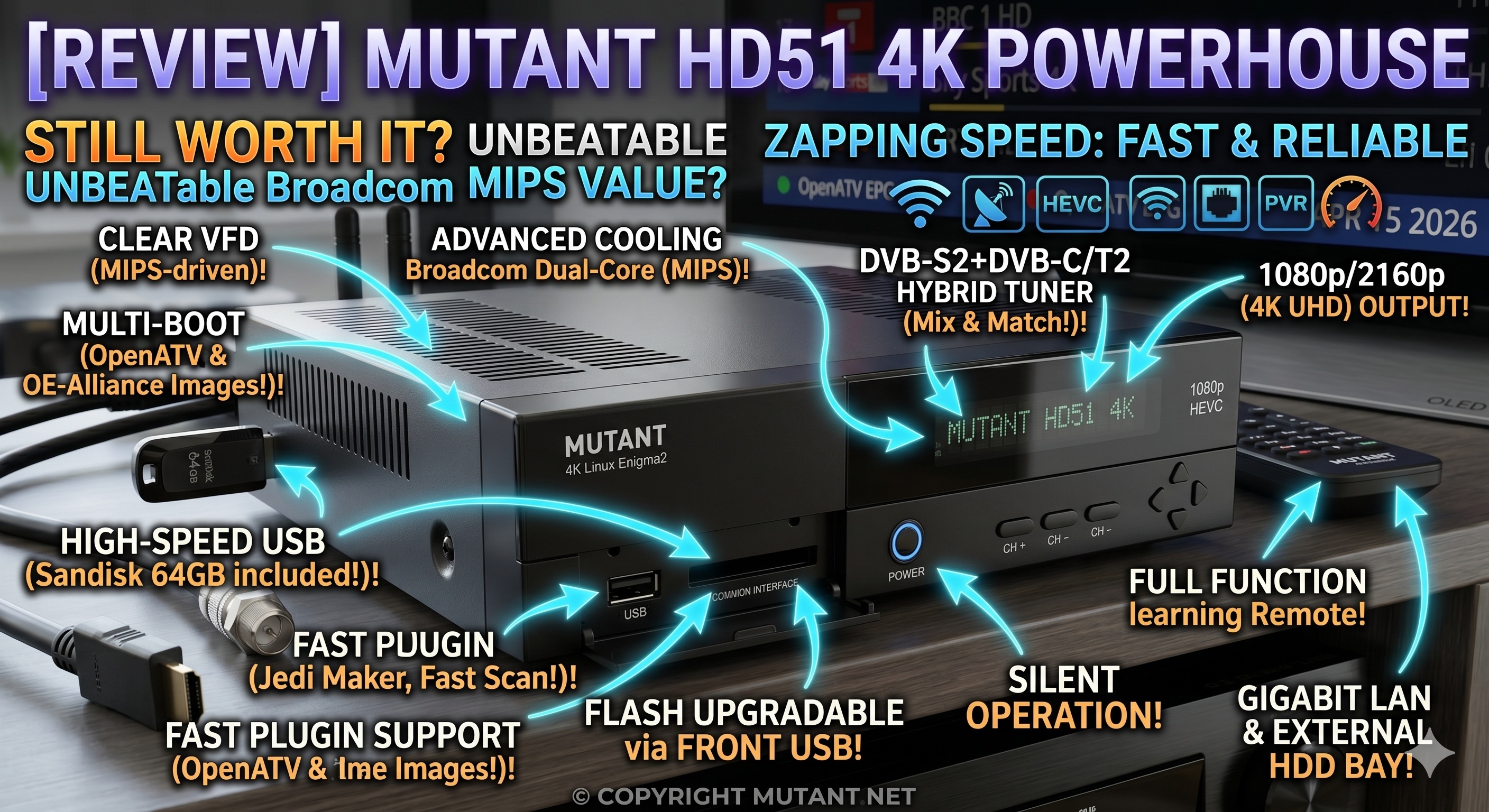
As an Enigma2 specialist, evaluating the Mutant HD51 in 2026 is an exercise in appreciating a “Golden Era” masterpiece. While many 4K receivers from its generation have faded, the HD51 remains a benchmark for what a reliable, open-architecture Broadcom box should be.
It was the first true “4K for the people,” and even today, it outperforms many modern, budget-friendly HiSilicon-based clones in terms of raw stability and image driver maturity.
## Technical Deep Dive: The Broadcom “Brahma” Core
At the heart of the HD51 is the Broadcom BCM7251S (Dual Core ARM Cortex A15). While newer boxes boast quad-core CPUs, the 12,000 DMIPS provided by this Brahma15 architecture is exceptionally efficient for Enigma2’s Linux environment.
### 1. The Storage King: 4GB eMMC
The most significant advantage the HD51 has over its younger sibling (the HD530C) or older MIPS boxes is the 4GB eMMC Flash.
-
Expert Insight: You are not restricted to one image. The HD51 was a pioneer in Multiboot support. In 2026, you can comfortably run OpenATV 7.4, OpenPLi 9.2, and PurE2 simultaneously on different partitions without ever touching a USB stick for “FlashExpanding.”
### 2. Tuner Versatility (Plug & Play)
Unlike integrated SoC tuners, the HD51 uses interchangeable PnP tuner slots.
-
You can run a Dual DVB-S2X configuration for 4K satellite.
-
You can swap in a DVB-C/T2 hybrid tuner if you move from satellite to cable.
-
Pro Tip: The drivers for the HD51 tuners are “Legacy Stable.” Unlike newer FBC (Full Band Capture) tuners which can sometimes suffer from frequency drift or software “locking” bugs, the HD51 tuners are remarkably resilient with low-threshold signals.
## 2026 Performance Metrics
| Task | Performance | Expert Notes |
| 4K UHD Playback | Excellent | Full H.265/HEVC 10fps support. HDR10/HLG works flawlessly. |
| Boot Time | Fast | Cold boot to picture in ~28-32 seconds on OpenPLi. |
| IPTV / Buffering | Solid | Gigabit LAN ensures no bottlenecks on 4K IPTV streams. |
| Internal HDD | Versatile | Supports 2.5″ SATA III internal drives (up to 4TB tested). |
## The “Expert” Optimization Checklist
If you are still running an HD51 in 2026, ensure your setup matches these professional standards:
-
GigaBit Networking: Ensure you are using the Ethernet port. While the HD51 supports USB Wi-Fi dongles, the Broadcom chip handles the Gigabit pipeline much better for high-bitrate 4K local streaming (via NAS).
-
USB 3.0 Utilization: Use the rear USB 3.0 port for your primary external media. The front ports are 2.0 and should be reserved for simple keyboard/mouse or temporary flashing.
-
Advanced Video Settings: For the best picture on modern OLED TVs, set the output to 2160p Multi and let the box handle the frame rate switching (24/50/60Hz) rather than forcing a static 60Hz.
## Final Verdict: Is it still viable?
Absolutely. The Mutant HD51 is the “ThinkPad” of Enigma2 receivers. It isn’t flashy, and it doesn’t have the fancy LCD screens of a Vu+ Duo 4K SE, but its driver stability is unparalleled.
-
Buy it if: You want a rock-solid 4K PVR with internal HDD support and perfect Multiboot capabilities.
-
Skip it if: You absolutely require 8K support or AV1 hardware decoding, which this older Broadcom chip lacks.
As of April 2026, the OpenPLi 9.2 and OpenATV 7.x teams are still releasing stable daily builds for this unit, proving that good hardware never truly dies in the Linux community.