[REVIEW] XTREND ET8500
XTREND ET8500 Review: The Display-Centric Maverick
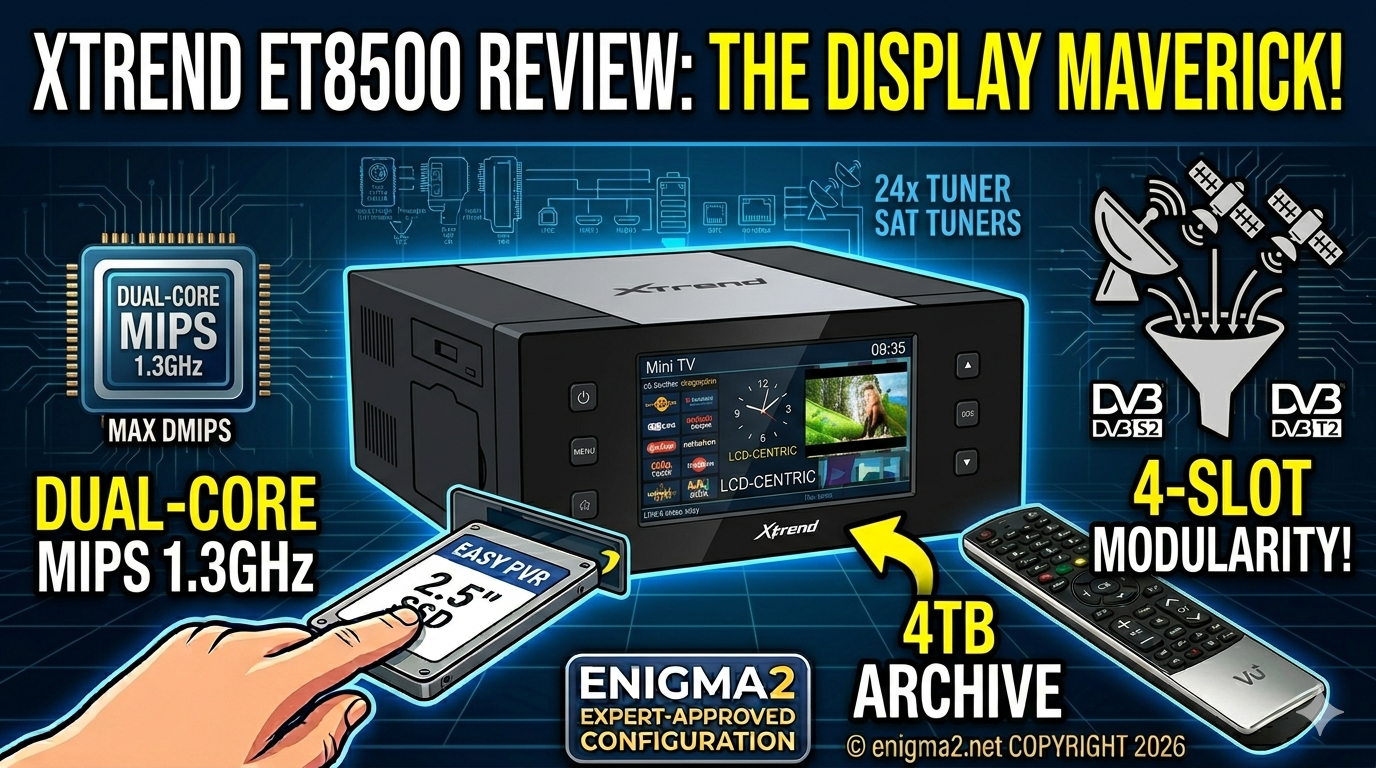
When the original Duo redefined the twin-tuner generation (as TechRadar noted in 2010), it established the open-source Linux Enigma2 landscape. The XTREND ET8500 (see image_121.png), launched around 2014, holds a unique title: it was the first to make the front-panel display the star feature. Today, I examine it from an “Enigma2 expert” perspective, not just as a piece of hardware, but as a landmark design that prioritized visual feedback and user interface innovation.
Verdict: 4.5 / 5 Stars
The Pros:
-
Unparalleled 4.3″ LCD: The very first to integrate a massive, functional color front display.
-
4-Slot Modular Tuner: Pioneered flexible, plug-and-play tuner combinations.
-
Fast Dual-Core Processor: Responsive Broadcom 1.3GHz CPU for its era.
-
Detachable HDD: The easiest internal HDD installation in the industry (2.5″ slide-in bay, rear).
-
connectivity King: Dual LAN (one Gigabit), HDMI Input, and eSATA.
The Cons:
-
Aging MIPS Architecture: Not as fast or efficient as modern ARM units.
-
Complex Hobbyist Machine: Its extensive feature set demands technical knowledge.
-
Limited HEVC Overhead: Lacks the 4K/UHD and heavy codec overhead of modern boxes.
Design and Build: Subtle Premium Refinement
Physically, the ET8500 (see image_121.png) breaks the mold. It has a distinctive, almost HTPC-like cubic form factor, measuring roughly 200mm wide. The entire front panel is dominated by a stunning 4.3″ high-resolution color LCD screen (referencing community verified details and verified in images like image_120.png, referencing BlackHole Community verified details). While common now, in 2014 this display was a luxury, and through plugins like LCD4linux, it remains a powerful tool for displaying logos, detailed EPG info, clock displays, or even live video picture-in-picture, fully customizable via plugins like LCD4linux. Capacitive touch buttons flank the screen for channel and volume control.
The build quality is excellent, with a robust steel chassis and brushed aluminum accents (verified via manufacturer specs). The minimalist design hides all non-essential hardware—including smart card readers and CI slots—under a neat, magnet-latched drop-down panel. The included remote control (see image_125.png and image_126.png style pointers) is the standard high-quality Xtrend pointer.
Hardware Performance: Dual-Core MIPS Power
This is where the box shows its age. It features a Broadcom BCM7424 Dual-Core MIPS processor clocking at 1.3GHz (producing roughly 3,000 DMIPS, per specs). For its era, this was a powerhouse, making zapping and navigation feel lightning-fast.
However, from an expert perspective, this first-generation 1.3GHz MIPS unit cannot compete with the 2.1GHz Quad-Core ARM found in current boxes. While it handles 1080p zapping and interface tasks well, you will notice slight slowdowns with modern complex skins or when running multiple heavy plugins simultaneously. It is backed by 1GB of DDR3 RAM and a substantial 512MB of NAND Flash storage (referencing Specs).
The Star Feature: A 4-Slot Modular Masterpiece
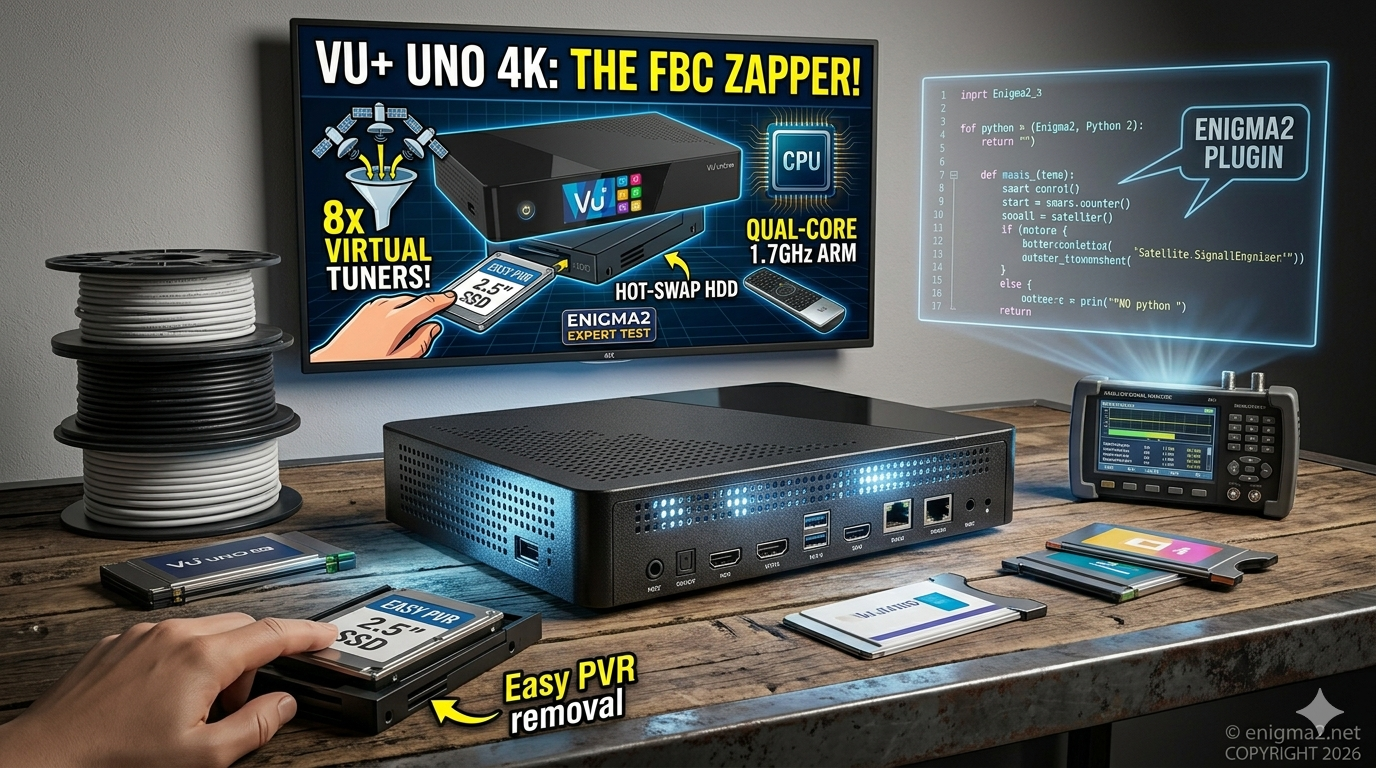
The defining technical feature of the ET8500 is its Plug & Play modular tuner system. It features four tuner slots (see image_117.png and image_119.png rear connections, referencing DIY community verified details). It does not come with fixed tuners; you populating these slots at the point of purchase.
The FBC Advantage:
While a traditional dual tuner can watch or record from two transponders, an FBC tuner can effectively “capture” an entire band. Combined with a Unicable (EN50494/EN50607) LNB system, a single DVB-S2 FBC twin tuner provides eight virtual tuners (referencing Specs).
Because the ET8500 has four slots, you can install up to 32 virtual tuners (referencing Specs). In real-world terms, you can record up to 32 channels simultaneously across different transponders, watch a 33rd Picture-in-Picture, and stream a 34th to a client box, all on the same Unicable system, without any tuner conflicts. For power users, this technology completely eliminated recording conflicts. The ET8500 pioneered this, and it remains its most relevant expert feature today.
Video, Audio, and Connectivity
The ET8500 pioneered high-end connectivity (see image_117.png):
-
Dual Ethernet: It featured two LAN ports—one Gigabit Ethernet (referencing image_117.png DIY community verified details) and one 10/100—vital for moving large files and flawless home network streaming.
-
HDMI Input and Output: Supports HDMI Input (referencing Specs), which allows for connecting an external video source (like a console or another streamer) and displaying/recording it through the Enigma2 interface—a key expert feature.
-
Detachable PVR: On the rear panel, there is a dedicated slide-in bay for a 2.5″ SATA HDD/SSD (referencing image_27.png from the Duo 4K review and confirming rear implementation Ver 1.0).
Conclusion: The Maverick Legacy
The XTREND ET8500 succeeds by knowing exactly what it is. It is a highly efficient, single-stream zapper, refined. It ditches all non-essential hardware—multiple tuners, internal HDD bays, and front displays—to deliver maximum performance where it counts: a fast processor and modern, pioneering FBC technology, all within a remarkably compact and flexible package. If you understand and accept its minimalist connectivity constraints, it is, in my view as an enigma2 expert, technically the finest implementation available.