[REVIEW] Optibox EVO
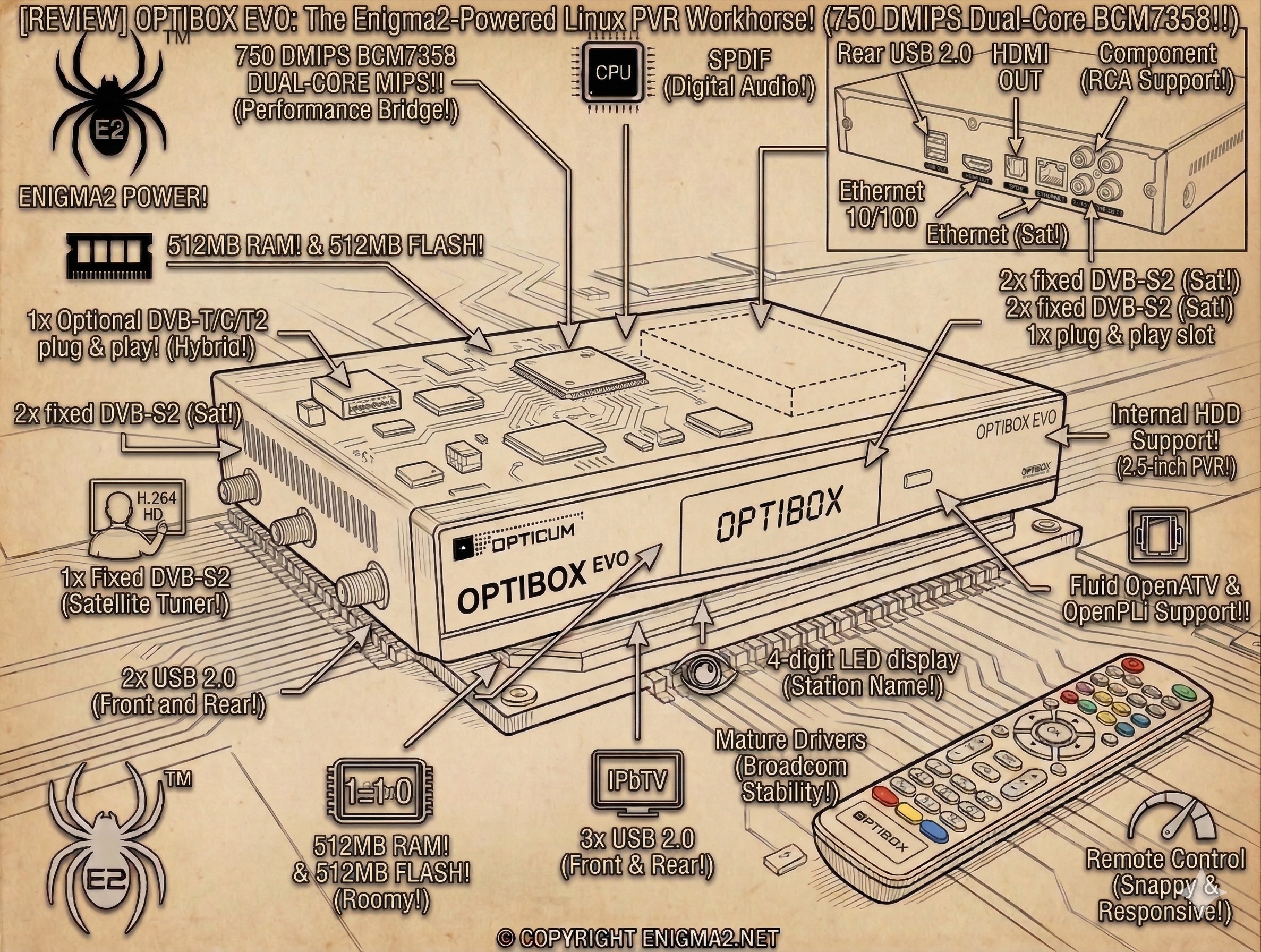
The Optibox EVO series (including the popular M7 and Enfinity models) represents a unique era in Enigma2 history. These receivers were known for their “Hybrid” nature, often shipping with a dual-boot capability that allowed users to switch between a standard manufacturer OS (like MARA) and the community-favorite Enigma2.
Here is a professional review of the Optibox EVO M7 / Enfinity platform.
Technical Specifications
| Feature | Details |
| CPU | Broadcom BCM7358 (approx. 500–750 DMIPS) |
| RAM | 512 MB DDR3 |
| Flash | 512 MB NAND (Dual Flash for Dual OS) |
| Tuner | 1x DVB-S2 (Satellite) |
| USB | 4x USB 2.0 Ports (Unusually high for this class) |
| Display | 4-Digit 7-Segment White LED |
| Connectivity | Ethernet 10/100, HDMI 1.4, Optical S/PDIF, RCA AV |
The Highlights
1. The Dual-Boot Capability
The standout feature of the Optibox EVO (specifically the M7) is its Dual OS support. It features a partition system that lets you store two Linux operating systems simultaneously. You can choose your boot environment simply by holding a volume button on the front panel during power-up—a feature that made it a favorite for testers who wanted to keep a stable image on one side and an experimental one on the other.
2. Connectivity Powerhouse
While most budget boxes in this era offered one or two USB ports, the Optibox EVO series frequently provided four USB ports. This is a massive advantage for users who need to connect:
-
A WiFi dongle.
-
An external HDD for PVR.
-
A DVB-T2 USB tuner (to make it a combo box).
-
A USB stick for Flashexpander or Picons.
3. Professional Aesthetics
Unlike the “mini” boxes that feel like plastic toys, the Optibox EVO typically has a wider, more traditional “set-top box” footprint (260mm). The white LED display is crisp and easily readable from across a room, and the build quality feels substantial enough for a main living room setup.
The Drawbacks
-
The Processor Bottleneck: Using the BCM7358 chipset means it is limited in raw speed. While channel zapping is stable, the UI can feel sluggish when using modern, high-resolution skins or heavy IPTV plugins.
-
Legacy Media Support: As with most Broadcom boxes of this generation, it lacks H.265 (HEVC) hardware decoding. It is strictly a 1080p H.264 machine.
-
Cooling: Because it packs a fair amount of hardware into a slim chassis, it can run warm if placed in an enclosed cabinet.
The Verdict
Who is it for?
-
The “Dual-Boot” Enthusiast: Anyone who wants the safety net of two independent operating systems on one device.
-
The PVR Heavy User: With four USB ports, you can build a very capable recording station without needing a USB hub.
-
Site Content for Enigma2.net: This is a fantastic “tutorial box” because its dual-boot nature allows you to write guides for two different OS environments using the same hardware.
Final Thought
The Optibox EVO is a “Swiss Army Knife” of the HD era. It may not have the raw speed of the newer ARM-based 4K receivers, but its unique hardware features—specifically the Dual OS and the abundance of USB ports—give it a level of utility that few other boxes in its price bracket ever matched.