[REVIEW] VU+ ZERO 4K
VU+ ZERO 4K: An OE-Alliance/Broadcom Deep-Dive Review
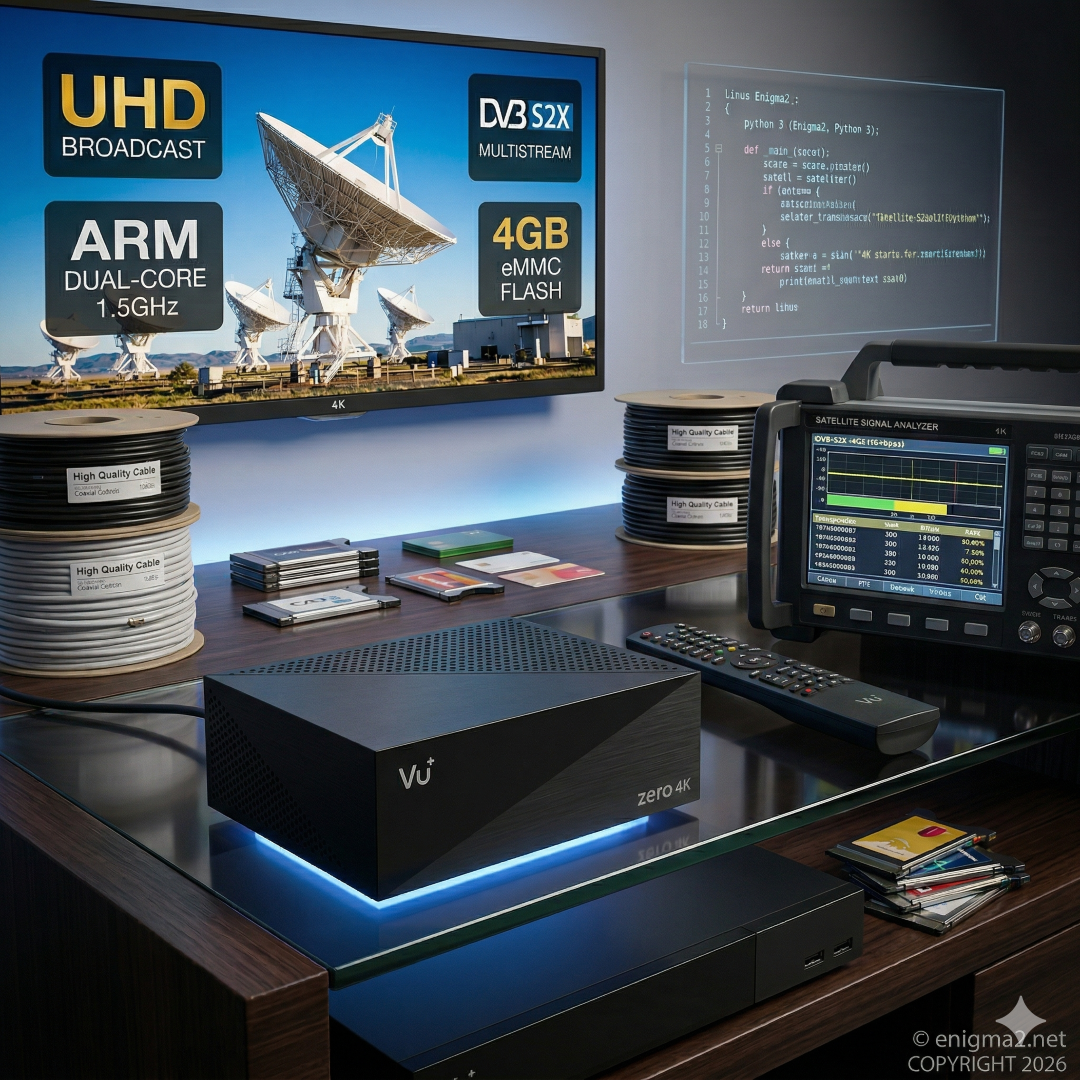
The VU+ ZERO 4K (see image_0.png) is not just an entry-level set-top box; from an Enigma2 perspective, it represents a precise engineering compromise that defined the entry-level UHD landscape. While users see a “cheap VU+,” developers and power users see a minimalist platform built around a robust, efficient Broadcom architecture designed specifically to lower the cost barrier to entry for DVB-S2X multistream and 4K playback.
This is a technical dissection of why the Zero 4K remains a highly relevant, single-tuner workhorse.
Hardware Architecture and OE Compatibility
The core of the Zero 4K is its Broadcom BCM72604 SoC (System on a Chip). This is a Dual-Core ARM processor clocking at 1.5GHz (producing roughly 7,000 DMIPS). Critically, this ARM architecture (as opposed to older MIPS cores) is what enables modern Enigma2 images to feel so responsive.
Memory Management:
-
Flash: 4GB eMMC. This is substantial. For an Enigma2 box, this means power users will never struggle with storage space for plugins, picons, complex skins, or extensive EPG data. You don’t need to mount external USB sticks for image space (flashexpander is obsolete here).
-
RAM: 2GB DDR4. This is the sweet spot for a single-tuner machine. It provides enough overhead to run a full OE-Alliance image (like OpenATV 7.x) alongside demanding plugins like Chromium OS, IPTV players, and multiple softcams, without the box resorting to swap space.
OE (Open Embedded) Image Support:
The machine has exceptional support across all OE-Alliance branches (OpenPLi, OpenATV, OpenViX, etc.) as well as the manufacturer-specific VTi and BlackHole images. Because VU+ provides stable BSP (Board Support Package) drivers, you can expect long-term image support. It handles the migration to Python 3 (standard in newer Enigma2 images) flawlessly.
DVB Frontend: The Tuner Compromise
The Zero 4K features a fixed tuner architecture. You must decide at the point of purchase whether you want satellite or terrestrial/cable. Unlike its higher-end siblings (DUO 4K, ULTIMO 4K), it does not support Plug & Play tuners.
Satellite Variant (BCM45308 Tuner):
The standard satellite configuration is a DVB-S2X Multistream tuner. This is crucial for certain regions (e.g., Italy, France) where specific transponders use multistream technology to bundle multiplexes. The tuner is highly sensitive and supports all standard DiSEqC protocols (1.0, 1.1, 1.2, USALS) and Unicable/SCR/Jess configurations (EN50494/EN50607). In a Unicable setup, you can record one channel and watch another on the same transponder, but this remains a strictly single-stream frontend. It does not have the “virtual tuners” of FBC (Full Band Capture) technology.
Video & Audio Path:
It fully supports HDMI 2.0b, enabling 2160p60 output. The Broadcom SoC provides hardware decoding for H.265/HEVC (main 10 profile), which is essential for nearly all 4K broadcasts and IPTV. It also supports VP9 (for some 4K streaming services) and AVS/AVS+. High Dynamic Range (HDR) support includes HDR10 and HLG. Audio bitstreaming via HDMI or the Optical S/PDIF (see image_3.png) handles Dolby Digital Plus and DTS flawlessly.
Real-World Networking & Connectivity Pitfalls
While the SoC is fast, the connectivity options (see image_3.png) are where the Zero 4K shows its “entry-level” constraints. Power users need to be aware of these limitations.
The Gigabit Omission:
The network interface is 10/100 Mbps Ethernet. For an expert, this is the main drawback. While 100Mbps is technically sufficient for streaming 4K satellite TS streams (which rarely exceed 60-80Mbps peaks), it offers zero overhead. If the network is busy, or if you are using the box as a server to stream to multiple clients, you will hit the bandwidth ceiling. It also makes FTP file transfers of large PVR recordings painfully slow.
USB Limitations:
There is only one USB 2.0 port on the rear (see image_3.png).
-
USB 2.0 vs 3.0: The transfer speed is adequate for recording a single HD or 4K channel to an external HDD/SSD, but it cannot handle the simultaneous I/O load of multiple recordings and timeshifting that USB 3.0 can.
-
Only One Port: If you connect an external PVR drive, you have nowhere to plug in a USB Wi-Fi dongle (as the Zero 4K lacks internal Wi-Fi). You are forced to use a USB Hub, which introduces more points of failure and bandwidth bottlenecks.
CI & Smart Card slots:
The presence of both a Rear Smart Card reader (Xcrypt) and a Common Interface (CI) slot (see image_3.png) provides excellent flexibility. From an expert perspective, this allows for proper handling of official subscription cards using softcams (like Oscam) or official CI+ modules (depending on image support).
Enigma2 Troubleshooting Perspective
As an enigma2 expert, I evaluate a box on how easily it can be recovered. The Zero 4K is extremely robust.
-
Flashing: The flashing process (USB stick in the rear port, power on) is reliable. The 4GB eMMC flash partition layout is robust, reducing the risk of bad sectors or corrupt filesystem tables.
-
Crash Logs: The Dual-Core ARM processor means that when an Enigma2 GSod (Green Screen of Death) occurs, the box generates the
enigma2_crash.logquickly, and the system restart is fast (under 40 seconds). -
Thermal Management: The Broadcom SoC runs relatively cool. The case (see image_2.png) provides adequate passive ventilation, and I have rarely seenthermal throttling issues, even in warm environments, provided the top vents are clear.
Conclusion: The Technical Verdict
The VU+ ZERO 4K is a masterclass in compromise. It focuses all its hardware prowess on what matters most for a basic setup: a fast processor, excellent driver stability, and modern DVB frontend compatibility (DVB-S2X).
It is not a media server. It is not a multi-tuner PVR. Its networking constraints (10/100 LAN, single USB 2.0) are significant bottlenecks for advanced network topologies.
However, if you need a dependable, responsive, and 4K-capable Enigma2 zapper or a managed IPTV/Streaming client with the backing of the best OE images available, the Zero 4K is, technically, the most efficient solution in its class.