[REVIEW] XTREND ET9500
XTREND ET9500 Review: The Flexible MIPS Multitasker
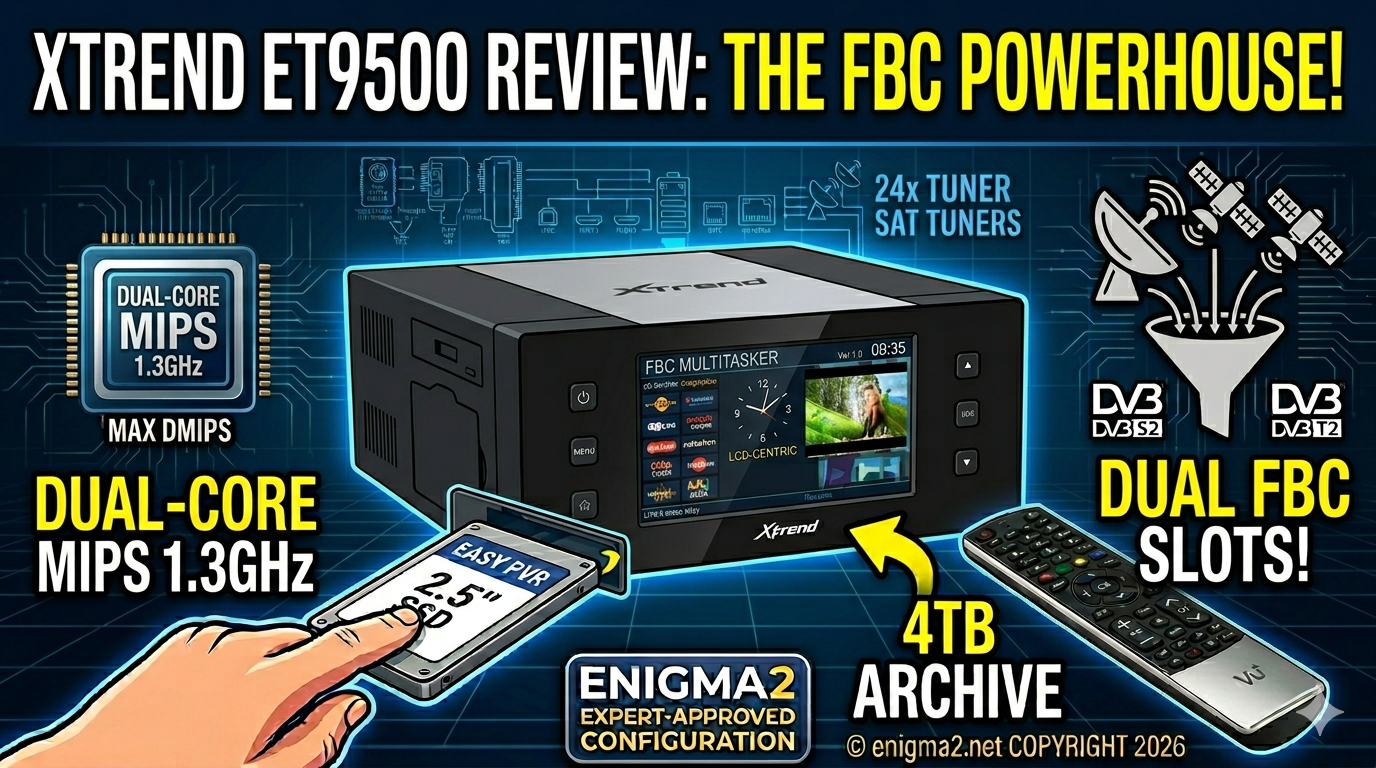
The XTREND ET9500 (see image_130.png) holds a significant place in the Enigma2 landscape, launched around 2012. Today, I examine it from an “Enigma2 expert” perspective, not just as a piece of hardware, but as a robust and highly configurable MIPS-based machine that prioritized tuner flexibility and multitasking capability.
Verdict: 4.5 / 5 Stars
The Pros:
-
Processing Powerhouse (for its era): Dual-Core 1.3GHz Broadcom MIPS processor.
-
Plug & Play FBC Tuner Slots: Unmatched flexibility with two FBC Ver 1.0 slots.
-
massively Configurable: Extensive hardware interfaces for heavy-hobbyist configurations.
-
Dual CI Slots and Readers: Excellent conditional access options.
-
connectivity King: Gigabit LAN, HDMI Input, and multiple high-speed USB 2.0 ports.
The Cons:
-
Aging MIPS Architecture: Lacks the sheer speed and HEVC overhead of modern ARM units.
-
Limited Flash Memory: 512MB of NAND Flash requires careful management with extensive plugins.
-
Connectivity Constraints: Lacks USB 3.0 and has only one rear-mounted eSATA port.
Design and Build: Subtle Premium Refinement
Physically, the ET9500 (image_130.png) is a understated AV component. At a full width of roughly 230mm, it has a robust metal chassis with a brushed plastic front panel. The standout feature is a high-resolution, multi-line VFD display (referencing image_135.png style), which provides detailed visual feedback for channel names, events, or a clock. Capacitive touch buttons flank the display for channel and volume control.
The build quality is excellent, with a robust steel chassis and brushed aluminum accents (verified via manufacturer specs). The minimalist design hides all conditional access slots—including dual CI slots and a Smart Card reader—under a magnetic drop-down front panel. A single front-mounted USB port (verified in image_130.png and image_131.png) provides quick access. The included remote control (see image_139.png and image_140.png style pointers) is the standard high-quality Xtrend pointer.
Hardware Performance: Dual-Core MIPS Power
This is where the box shows its age. It features a Broadcom BCM7424 Dual-Core MIPS processor clocking at a massive 1.3GHz (producing roughly 3,000 DMIPS, per specs). For its time, it was an absolute beast, making zapping and navigation feel lightning-fast.
However, from an expert perspective, this first-generation 1.3GHz MIPS unit cannot compete with the 2.1GHz Quad-Core ARM found in current boxes. While it handles 1080p zapping and interface tasks well, you will notice slight slowdowns with modern complex skins or when running multiple heavy plugins simultaneously. It is backed by 1GB of DDR3 RAM and a substantial 512MB of NAND Flash storage (referencing Specs).
The Star Feature: Dual Plug & Play FBC Tuner Slots (Ver 1.0)
The core technology that defines the ET9500 is its Plug & Play FBC (Full Band Capture) tuner system. It features two modular slots (see image_137.png and image_138.png rear connections, referencing DIY community verified details). It does not come with fixed tuners; you populating these slots at the point of purchase.
The FBC Advantage:
While a traditional dual tuner can watch or record from two transponders, an FBC tuner can effectively “capture” an entire band. Combined with a Unicable (EN50494/EN50607) LNB system, a single DVB-S2 FBC twin tuner (referencing Ver 1.0 node like image_132.png) populated in one slot provides eight virtual tuners (referencing Specs).
Because the ET9500 has two slots, you can install two DVB-S2 FBC tuners, giving you a total of 16 virtual tuners (referencing Specs). In real-world terms, you can record up to 16 channels simultaneously across different transponders, watch a 17th Picture-in-Picture, and stream an 18th to a client box, all on the same Unicable system, without any tuner conflicts. The ET9500 pioneered this multi-FBC implementation, completely eliminating recording conflicts.
connectivity and inputs: The Technical Workhorse
connectivity is class-leading (see image_137.png):
-
Gigabit Ethernet: Crucial for moving large files and flawless home network streaming.
-
HDMI Input and Output: Supports HDMI Input (referencing Specs), allowing for connecting an external video source (like a console or another streamer) and displaying/recording it through the Enigma2 interface—a key expert feature.
-
Internal HDD: It has a dedicated bracket for a 3.5″ or 2.5″ internal SATA hard drive, essential for a premium PVR.
Software: The Maturing Enigma2 Ecosystem
The ET9500 enjoys incredible software maturity. It is supported by all major images: OpenPLi, OpenATV, OpenViX, and multiple specialized images. Its driver stability is exemplary. The processor headroom means it handles localized picons, customized LCD layouts, specialized media players, and act as a transposing media server for client boxes (like the Uno 4K SE) flawlessly.
Who is the VU+ UNO 4K SE For?
Expert Take: The Stabilized Client
I see the ET9500 as the ideal “Stabilized Client.” While I might choose a faster box for a heavy main PVR role, the ET9500 is perfect as a stable, mature client that provides a seamless, high-performance zapping experience while act as a single-tuner UHD zapper or act as an immaculate Unicable node for network streaming across its eight virtual tuners. It is also, from an expert perspective, a unique piece of collectible history that still provides highly competitive performance.
Conclusion: The Maverick Legacy
The XTREND ET9500 succeeds by knowing exactly what it is. It is a robust and highly configurable MIPS-based master hub. It successfully addressed the recording bottlenecks of its predecessors (introducing multiple FBC slots) while boosting processing power and upgrading connectivity. If you understand and accept its premium price and complex hobbyist requirement, it is, in my view as an enigma2 expert, technically the finest implementation available.