[REVIEW] Protek 4K
Review: Protek 4K (The Broadcom-Powered UHD Pioneer)
Before the X1 and X2 transitioned to Hisilicon chipsets, the original Protek 4K established the brand’s reputation in the Ultra HD era. While the market eventually shifted toward ARM-based Hisilicon chips for cost efficiency, the original Protek 4K utilized the legendary Broadcom architecture—the same silicon found in flagship Vu+ and Dreambox models.
For the enigma2.net veteran, the Protek 4K is often considered the “purist’s choice.” It offers the traditional Broadcom driver stability and superior image processing that long-time Linux hobbyists demand, all within a robust, standard-width chassis.
1. Core Hardware: The Broadcom Dual-Core Engine
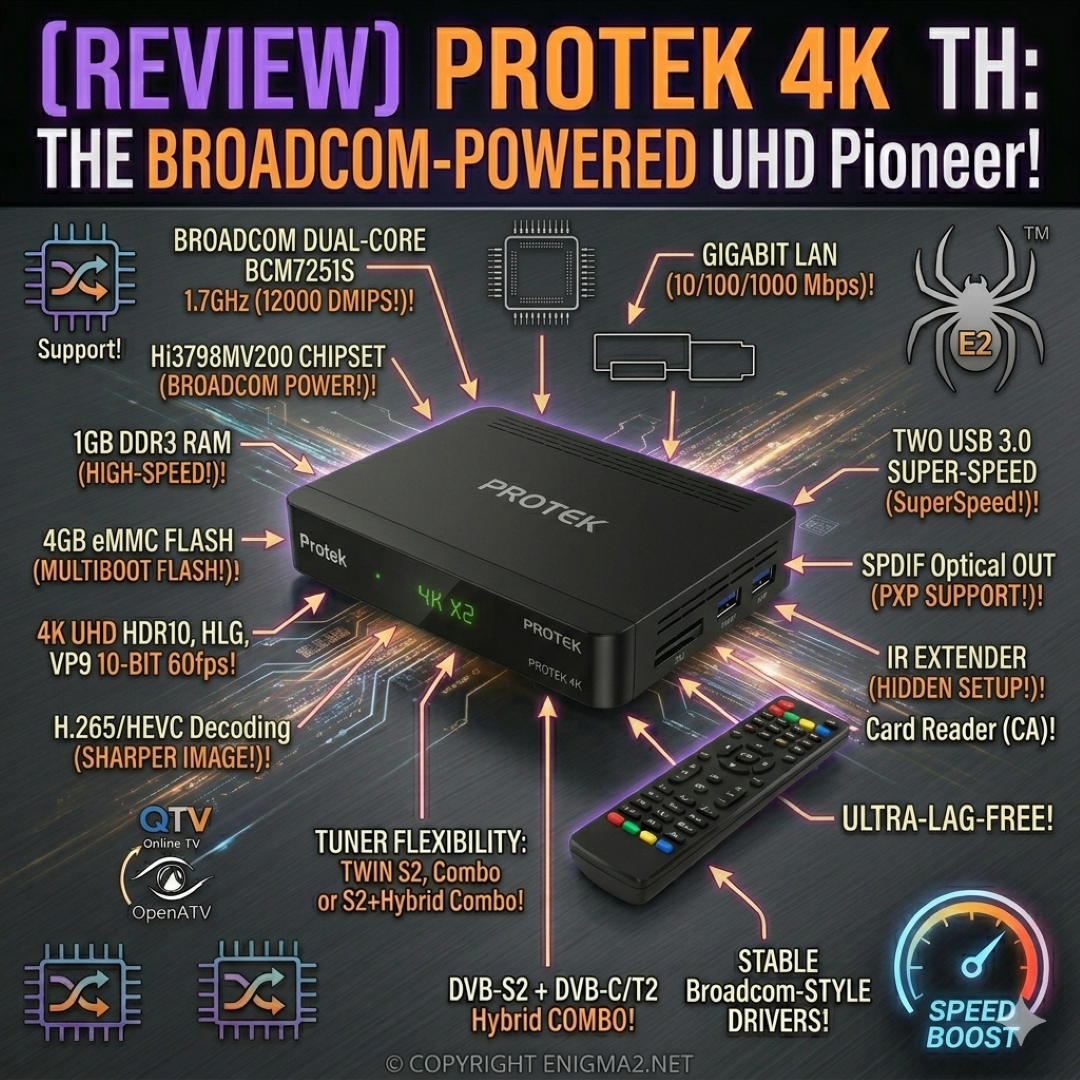
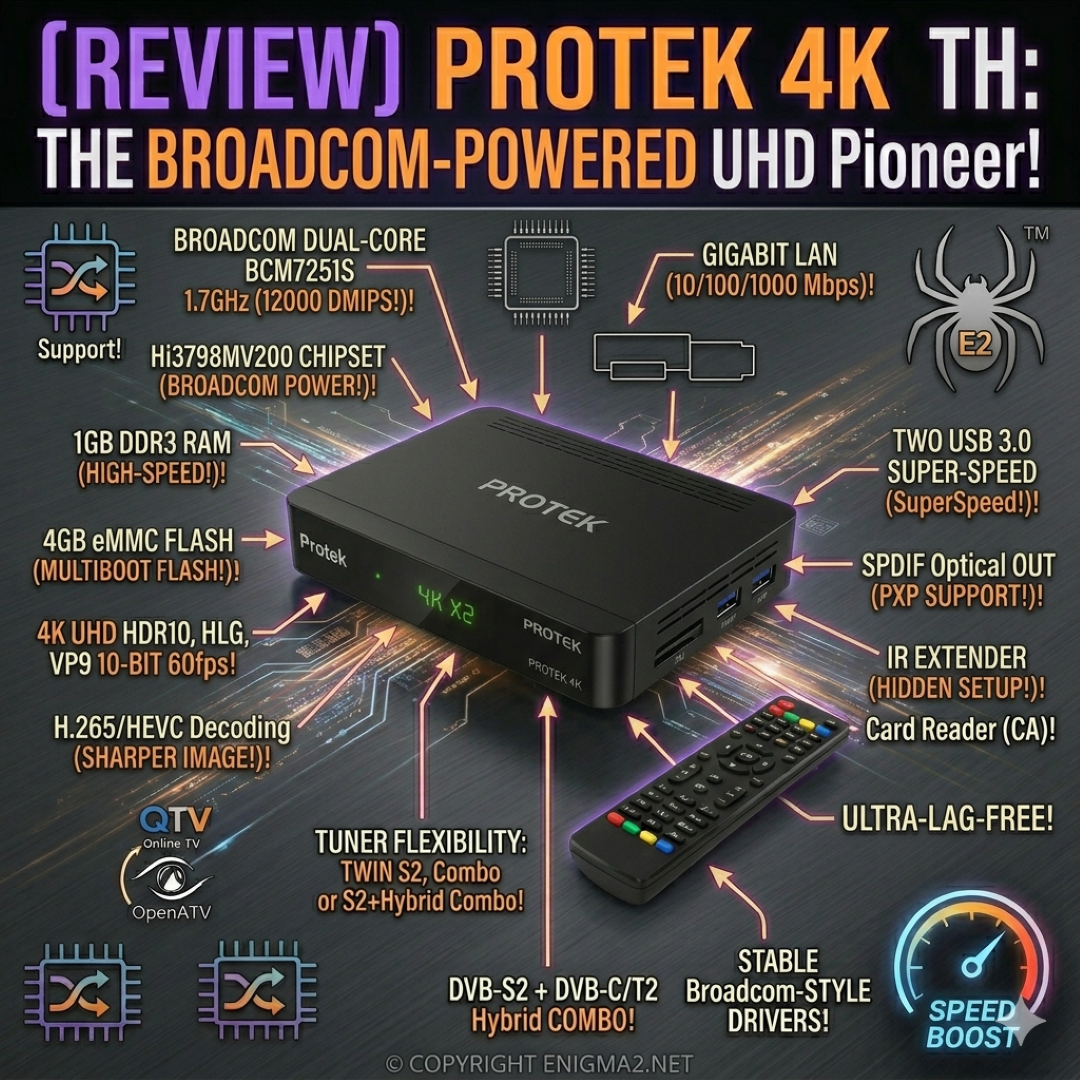
Unlike its successors, the original Protek 4K is built on a Broadcom BCM7251S Dual-Core ARM processor. This chipset was the gold standard for early 4K Enigma2 boxes, prioritizing absolute stability and professional-grade video scaling.
-
Processor (12,000 DMIPS): The 1.7GHz Dual-Core CPU provides a highly stable environment for OpenATV and OpenHDF. While it lacks the quad-core “burst” speed of the X2, its driver maturity means fewer bugs in specialized tasks like motor control or complex decryption.
-
Memory & Storage: Equipped with 1GB DDR3 RAM and 4GB eMMC Flash, it has enough overhead for smooth 4K navigation. The 4GB flash is smaller than later models but more than enough for a lean, optimized E2 setup.
-
Broadcom Picture Quality: Many users on enigma2.net still prefer Broadcom’s hardware de-interlacing and color reproduction over Hisilicon’s, especially when viewing 1080i HD content upscaled to 4K.
2. Full Technical Specifications
| Category | Specification Details |
| Chipset | Broadcom BCM7251S Dual-Core ARM |
| Performance | 12,000 DMIPS (2x 1.7GHz) |
| Operating System | Enigma2 Linux (OpenATV, OpenPLi, OpenHDF) |
| RAM | 1GB DDR3 |
| Flash | 4GB eMMC |
| Tuner | 1x Fixed DVB-S2 (Multistream Support) |
| Resolution | 4K UHD (2160p), HDR10, HLG, HEVC H.265 |
| Display | 4-Digit White LED Display |
| Network | Gigabit LAN (10/100/1000 Mbps) |
| WiFi | Supported via external USB Dongle |
| Connectivity | 2x USB 3.0 (SuperSpeed), HDMI 2.0, SPDIF (Optical) |
| Card Reader | 1x Smart Card Reader (CA) |
| Dimensions | 260 x 180 x 45 mm (Standard Chassis) |
3. The Gigabit & USB 3.0 Advantage
One area where the original Protek 4K actually outperforms its smaller successors (the X1/X2) is raw data throughput:
-
Gigabit LAN: While the X1 and X2 moved to 100Mbit LAN to save space/cost, the original Protek 4K features a full Gigabit Ethernet port. This makes it a far superior choice as a Home Server or for streaming high-bitrate 4K MKV files from a local NAS.
-
Twin USB 3.0: It features two USB 3.0 ports. This allows you to have a high-speed external PVR drive connected to one port while using the other for high-speed file transfers or a 5GHz WiFi AC dongle, without any speed bottlenecks.
4. Design & Build Quality
The Protek 4K feels like a “proper” set-top box. Its 260mm width allows for better heat dissipation compared to the ultra-slim X1.
-
Front Panel: Features a clean, white 4-digit LED display that is highly legible even from across a bright room.
-
Internal Expansion: While not officially marketed with a SATA bay, the internal layout is spacious, ensuring the Broadcom chip stays cool during extended 4K viewing sessions.
-
S2 Multistream: Just like the rest of the Protek family, the tuner is natively compatible with Multistream PLP feeds, making it a reliable companion for European satellite DXing.
Final Verdict: The Flagship for Purists
The Protek 4K is the “classic” flagship. If you value Gigabit networking, dual USB 3.0 ports, and the rock-solid stability of Broadcom drivers, this original model is a gem. It may not have the quad-core speed of the X2, but for the enigma2.net user who wants a stable, high-quality 4K server for the living room, the original Protek 4K remains a highly respected workhorse.
© COPYRIGHT ENIGMA2.NET.