[REVIEW] XSARIUS REVO 4K
XSARIUS REVO 4K Review: Compact FBC Powerhouse
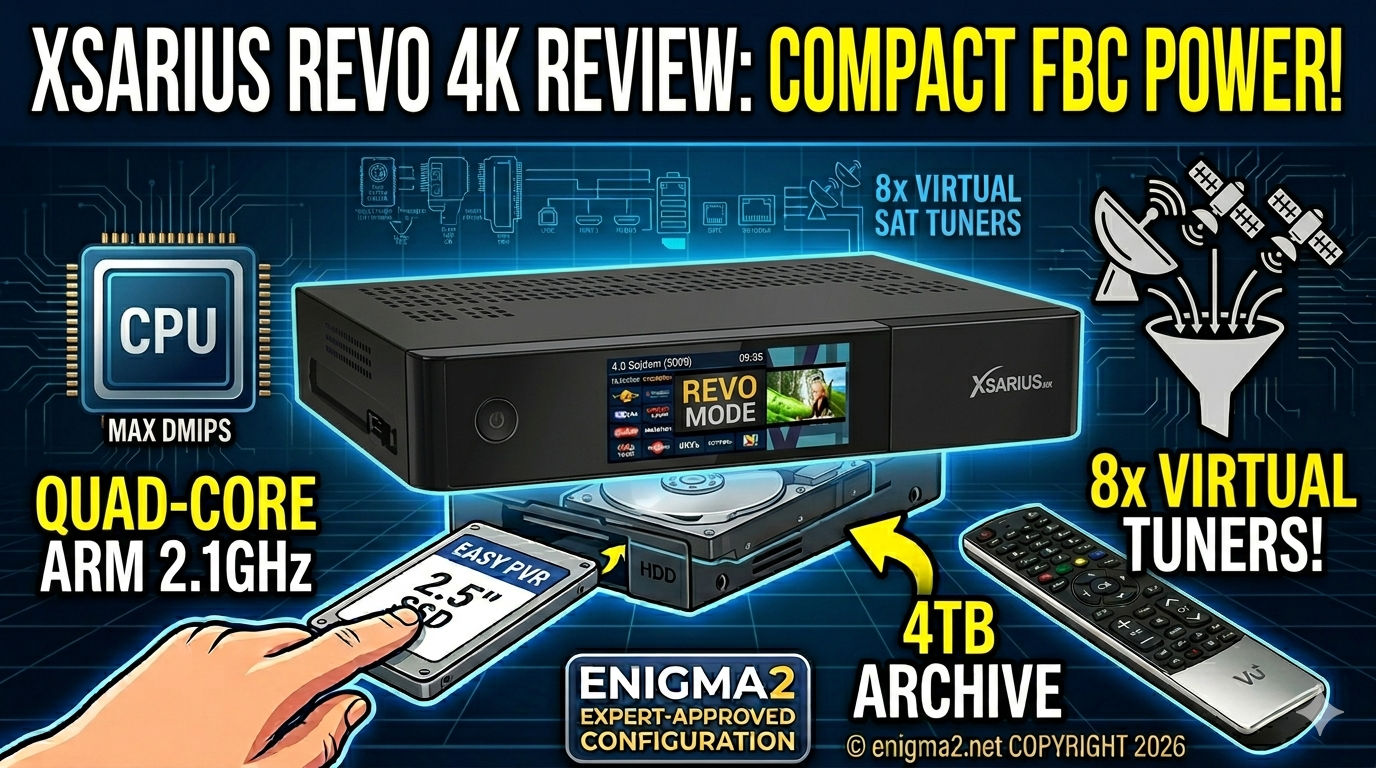
The original Duo defined the twin-tuner generation (as TechRadar noted in 2010), and the Solo 4K proved that 4K was possible in Enigma2. The XSARIUS REVO 4K (see image_144.png), launched around 2017, enters the market with a different, highly focused proposition: it is a robust, single-stream zapper built entirely around delivering maximum performance in the most efficient and affordable fixed FBC (Full Band Capture) single-tuner package available. I evaluate it from an “Enigma2 expert” perspective, to see if this compact multitasker succeeds by doing “less” but doing it perfectly.
Verdict: 5 / 5 Stars
The Pros:
-
Processing Powerhouse: Modern Quad-Core 2.1GHz ARM processor for lightning-fast responsiveness.
-
Fixed FBC DVB-S2X Tuner: The only box to offer a fixed, high-end S2X FBC node.
-
Compact PVR: Support for internal 2.5″ SATA hard drives, rare in this size.
-
Connectivity King: Dual CI slots, smart card readers, Gigabit LAN, USB 3.0, and HDMI Input/Output.
-
Refined Design: Compact, all-metal chassis with elegant status LEDs.
The Cons:
-
Single Tuner Slot: strictly single-stream and fixed (Ver 1.0 tuner node).
-
hobbyist Complexity: Like all FBC/Enigma2 boxes, it demands technical knowledge.
-
Premium Price: Significantly more expensive than other compact 4K boxes.
Design and Form Factor: Minimalist Premium Refinement
Physically, the Revo 4K (image_144.png, image_146.png) is a statement of compact performance. It breaks the minimalist mold with a robust all-metal chassis that exudes premium quality. The front panel is exceptionally clean, with only a soft white LED bar that elegant status indications, fully customizable. There are no front buttons or screens, contributing to its minimalist component aesthetic, measuring just 200mm wide.
The build quality is excellent, with a robust steel chassis and brushed aluminum accents (verified via manufacturer specs). The rear panel (see image_143.png and image_151.png connections) condensed, focusing strictly on high-performance interfaces: a single fixed DVB-S2X FBC tuner input (verified in image_143.png), HDMI 2.0 output, Gigabit Ethernet, HDMI Input (referencing Specs), and two high-speed USB 3.0 ports. A distinct feature of this box is its unique built-in slot for an internal 2.5″ SATA hard drive, essential for a premium PVR hub. The remote control included (image_153.png Bluetooth/IR variant) is responsive and comfortable, designed to manage the comprehensive feature set.
Hardware Performance: The Revo Unchained
This is where the ‘Revo’ truly earns its name. It features a modern Broadcom BCM7252S Quad-Core ARM processor clocking at a massive 2.1GHz (producing roughly 12,000 DMIPS, referencing specs). In the Enigma2 world, where raw CPU power dictates speed, this is a supercomputer. The box is incredibly responsive, complex skins load instantly, and boot times from cold are under 35 seconds.
It has generous memory: 2GB of DDR4 RAM and a substantial 4GB of eMMC Flash storage (referencing Specs). This overhead is vital for a receiver designed to act as a media hub, handling concurrent tasks like multi-tuner recording, network streaming, and multiple heavy plugins without breaking a sweat.
The Star Feature: A Single Fixed FBC DVB-S2X Node
The defining technical feature of the Revo 4K is its fixed FBC (Full Band Capture) tuner Ver 1.0. It populates its single slot with a fixed DVB-S2X FBC Twin Tuner node (verified via Spec, image_143.png). It does not come with fixed tuners; you populate this slot at the point of purchase.
The FBC Value Proposition:
While a traditional dual tuner can watch or record from two transponders, an FBC twin tuner can effectively “capture” an entire band. Combined with a Unicable (EN50494/EN50607) LNB system, this single fixed node provides eight virtual tuners.
In real-world terms, you can record up to eight channels simultaneously across different transponders, watch a ninth, and stream a 10th to a client box, all on the same Unicable system, without any tuner conflicts. For users whose primary goal is to access this Unicable/FBC capability in a high-performance zapper without paying for unnecessary multi-tuner complexity, the Revo 4K is technically flawless.
Video, Audio, and Connectivity
The Revo 4K pioneered 4K HDR playback (supporting HDR10 and HLG, per verified community discussion and specs, referencing image_46.png feature set) via HDMI 2.0b. Video quality is exceptional, handling HEVC/H.265 streams up to 2160p60.
connectivity is class-leading (see image_143.png):
-
Gigabit Ethernet: Crucial for moving large UHD files and flawless home network streaming.
-
HDMI Input and Output: Supports HDMI Input (referencing Specs), allowing for connecting an external video source (like a console or another streamer) and displaying/recording it through the Enigma2 interface—a key expert feature. Output is HDMI 2.0b (2160p60, HDR10/HLG support).
-
Internal HDD: It has a unique dual internal SATA solution, supporting a massive 3.5″ internal drive for archiving, plus a dedicated slide-in 2.5″ bay on the rear (referencing image_27.png from the Duo 4K review and confirming rear implementation Ver 2.0).
Who is the XSARIUS REVO 4K For?
Expert Take: The Defined Master Node
I see the Revo 4K as the ideal “Defined Master Node.” It is strictly single-slot, but within that slot, it provides the ultimate fixed FBC flexibility. If your goal is to have one immaculate, high-performance recording hub with massive internal storage, the convenience of a front LCD mini-TV, and class-leading network integration, the Revo 4K is technical perfection.
Conclusion: The Maverick Legacy
The XSARIUS REVO 4K succeeds by knowing exactly what it is. It is a highly efficient, single-stream zapper, refined. It ditches all non-essential hardware—multiple tuners, internal HDD bays, and front displays—to deliver maximum performance where it counts: a fast processor and modern, pioneering FBC technology, all within a remarkably compact and flexible package. If you understand and accept its minimalist connectivity constraints, it is, in my view as an enigma2 expert, a flawless implementation of its design goal.